8 Best Car Battery Testers (2026 Review Guide)
The Best Ranked Car Battery Tester
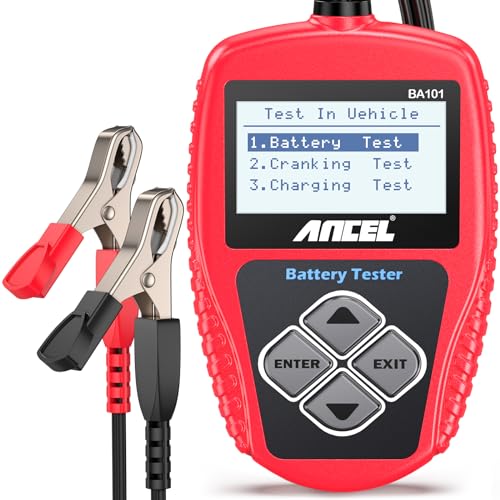
ANCEL BA101 12V Car Battery and Alternator Tester
The ANCEL BA101 is a compact and reliable diagnostic tool designed to quickly assess the health of 12V vehicle batteries and charging systems. Compatible with a wide range of battery types and vehicles, it offers accurate and easy-to-read test results through an intuitive interface and multilingual support. Ideal for ensuring your car, truck, boat, or RV battery performs optimally.
Key Features:
- Quickly tests battery health, voltage, cranking, and charging system performance
- Provides highly accurate diagnostics with advanced crocodile clips and intelligent chip technology
- Large LCD screen with adjustable contrast and backlight for clear, one-handed operation
- Built-in safety features protect against polarity reversal, short circuits, overcurrent, and overvoltage
- Compatible with various 12V battery standards including Flooded, AGM, GEL, and EFB batteries
- Supports multiple languages and includes a print function to save and share test data
- Not suitable for lithium, storage, or non-12V batteries; accurate results require correct input values
Pros
- Highly accurate and reliable battery and alternator testing
- User-friendly design with clear display and multilingual support
- Robust safety features to protect both user and equipment
Cons
- Not compatible with lithium or non-12V batteries
- Requires accurate input of battery specifications for correct results
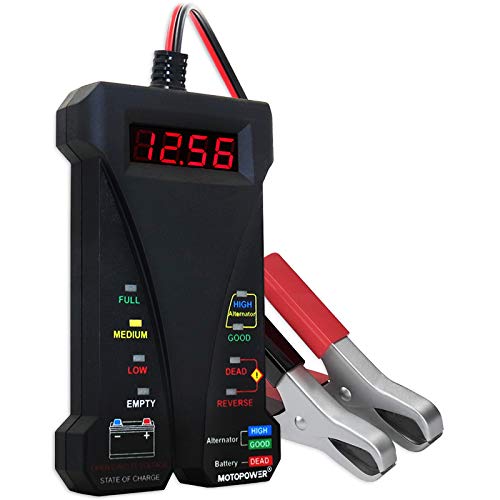
12V Digital Car Battery and Charging System Tester with LCD and LED Indicators
This compact and easy-to-use digital tester provides accurate readings for your car's battery and charging system. Designed for both professionals and everyday drivers, it offers reliable safety features and clear visual indicators to quickly assess the health of your vehicle's battery and alternator.
Key Features:
- Simple plug-and-test operation with no complex setup required
- Reads battery status without starting the vehicle and alternator status after engine start
- Reverse connection and over-voltage protection for enhanced safety
- High accuracy voltage readings with a 4-digit LCD display
- 8 colored LED indicators clearly show battery and alternator conditions
- Voltage detection range from 4V to 20V suitable for 12V batteries and other devices
- Includes 50cm extension cable and 30A alligator clips for versatile connections
- Durable black rubber-coated surface for secure grip and comfortable handling
- Lightweight and compact design for easy portability and storage
Pros
- User-friendly design requires no technical knowledge
- Accurate readings with clear digital and LED display
- Built-in safety features prevent damage from incorrect connections
Cons
- Limited to 12V batteries, not suitable for higher voltage systems
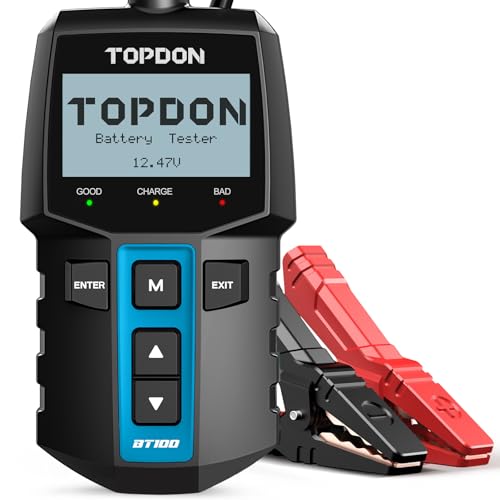
TOPDON BT100 12V Car Battery and Alternator Tester
The TOPDON BT100 is a compact and easy-to-use tester designed to evaluate 12V lead-acid batteries and automotive electrical systems. It provides accurate diagnostics on battery health, charge level, and engine starting power, compatible with various battery types and vehicles. Its intuitive LED indicators and safe testing method make it ideal for both professional mechanics and everyday vehicle owners.
Key Features:
- Tests 12V lead-acid batteries, including flooded, AGM, EFB, and GEL types with CCA range 100-2000
- Safe passive testing powers on only when connected, supporting cars, motorcycles, trucks, RVs, ATVs, boats, lawnmowers, and golf carts
- Performs battery health check, engine cranking test, and alternator charging system analysis
- User-friendly interface with LED color indicators and menu navigation
- Copper clamps with spark-proof and reverse polarity protection for secure connections
- Compact design fits easily in glove boxes or consoles for convenient storage
Pros
- Accurate testing across multiple battery types and vehicles
- Safe and easy to use with clear LED indicators
- Portable, compact size ideal for on-the-go diagnostics
Cons
- Limited to 12V systems only
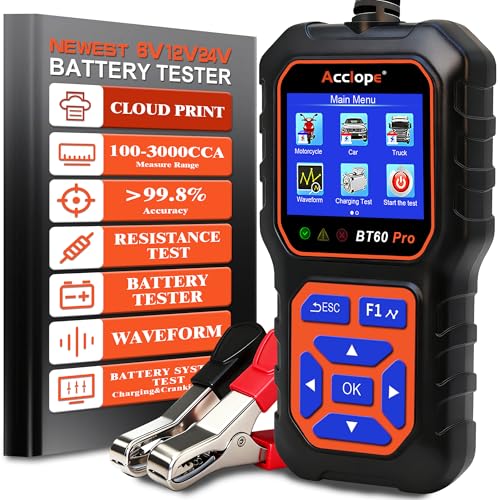
BT60 Pro Car Battery Tester with Cloud Printing and 6V/12V/24V Support
The BT60 Pro is a versatile and accurate battery tester designed for cars, motorcycles, and trucks. Supporting multiple battery types including lead-acid, AGM, GEL, and lithium, it offers comprehensive diagnostics like state of health, state of charge, voltage, resistance, and cold cranking amps. Featuring a 3.2-inch HD screen and intuitive interface, along with cloud printing capability via QR codes, it simplifies result sharing and record keeping. Its durable design and safety features make it suitable for both professional mechanics and DIY users.
Key Features:
- Compatible with 6V, 12V, and 24V batteries including lead-acid, AGM, GEL, EFB, and lithium types (LiFePO4 limited to voltage and health checks). Not compatible with 48V systems.
- Measures battery health, charge state, voltage, resistance, and cold cranking amps accurately using advanced conductance technology.
- High-precision chip delivers testing accuracy up to 99.8% for batteries from 2 to 120Ah capacity.
- Supports cloud printing of test results via QR code without needing an app, allowing easy sharing and record management.
- Dedicated 6V mode for motorcycles and small devices ensures precise diagnostics for smaller batteries.
- User-friendly interface with a clear 3.2-inch HD display and simple menu navigation.
- Durable ABS casing with anti-slip grip and long cables for comfortable and safe use in tight spaces.
- Wide-mouth clamps with LED lights improve safety by preventing overheating and short circuits during testing.
- Memory function stores recent test results and supports 12 languages for global usability.
- Performs reliably in extreme temperatures with cold and hot cranking tests to ensure battery performance under harsh conditions.
Pros
- Wide battery compatibility including modern lithium types
- Highly accurate and fast testing with advanced chip technology
- Convenient cloud printing feature for easy result sharing
Cons
- Limited support for LiFePO4 batteries only covers voltage and health checks
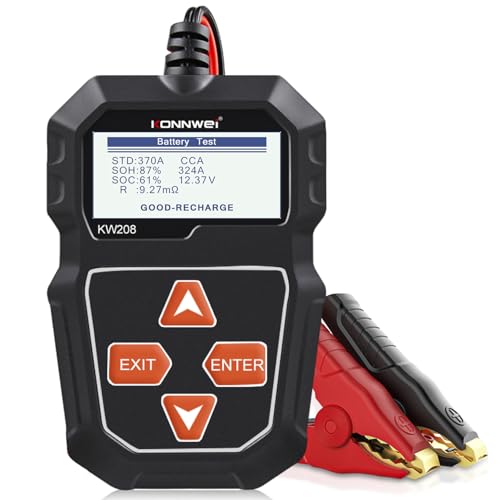
KONNWEI KW208 12V Automotive Battery and System Tester
The KONNWEI KW208 is a versatile and reliable 12V battery tester designed for cars, trucks, motorcycles, boats, and more. It provides fast, accurate diagnostics of battery health, cranking power, and charging systems, helping you prevent unexpected battery failures. Compact and easy to use, this tester supports multiple battery types and offers professional advice to recharge or replace your battery when needed.
Key Features:
- Tests all 12V batteries from 100 to 2000 CCA, including flooded, AGM flat plate, AGM spiral, and gel batteries.
- Analyzes battery condition, voltage, internal resistance, cold cranking amps (CCA), amp-hour capacity, health, and charge status.
- Measures cranking and charging systems, including alternator and starter testing.
- Durable galvanized alloy battery clips provide better contact and improve testing accuracy to 99.7%.
- Powered by an advanced AI chip for precise results in milliseconds.
- Simple plug-and-play operation works both in-vehicle and out-of-vehicle, even with dead batteries.
- Supports up to 8 languages for user convenience.
Pros
- Highly accurate and fast testing with over 99.7% precision.
- Supports various battery types and multiple system diagnostics.
- User-friendly setup with plug-and-play operation.
Cons
- Limited to 12V batteries only.
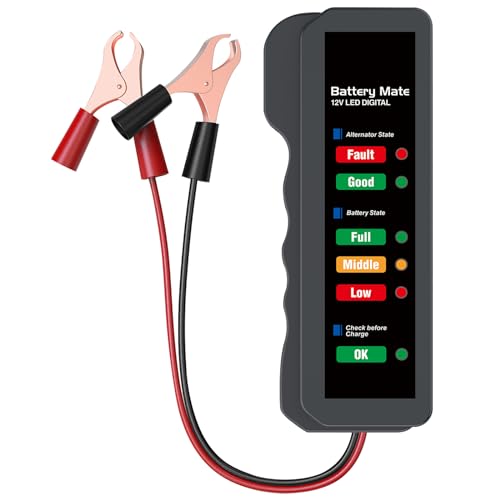
12V Car and Alternator Battery Tester with Load Indicator
This 12V battery tester provides a quick and easy way to check the health of your car battery and alternator. Suitable for various 12V battery types, it features clear LED indicators to show battery status, helping you avoid unnecessary replacements and keep your vehicle running smoothly.
Key Features:
- Tests battery health and alternator functionality to determine if recharging or replacement is needed
- Compatible with all 12V charging systems, including flooded, AGM flat plate, AGM spiral, and GEL batteries
- Six LED indicators show battery and alternator status: green (good), orange (moderate), red (low)
- Reverse polarity protection prevents damage from incorrect connection
- Copper wire and clips provide high conductivity and sensitivity
- Non-slip design allows easy use even when wearing gloves
- Dedicated customer support with 24-hour response time
Pros
- Easy-to-understand LED indicators for quick diagnosis
- Works with a wide range of 12V batteries and vehicles
- Durable build with reverse polarity protection
Cons
- Limited to 12V systems only
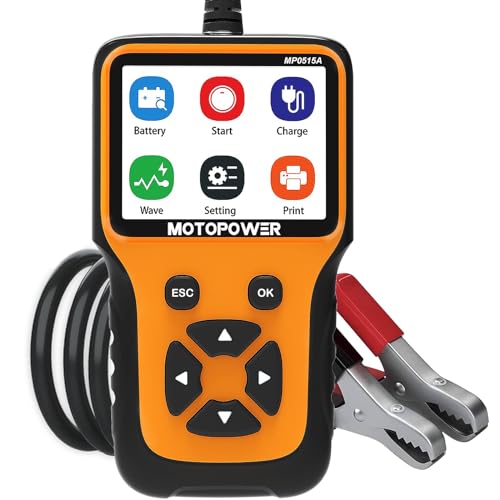
12V Car Battery and Alternator Tester with Load and Charging System Check
This 12V battery tester quickly checks the condition of your car battery and alternator. It offers accurate diagnostics on battery health, starting voltage, and charging performance, helping you decide if your battery needs a jump, replacement, or if your alternator is functioning properly. With a clear color display and multi-language support, this tester is an essential tool for any vehicle owner.
Key Features:
- Quickly tests 12V lead acid batteries from 100 to 2000 CCA for health, charging status, and internal resistance
- Analyzes battery condition and provides a clear result: mediocre, good, or excellent
- Checks alternator starting voltage and continuous power output while engine is running
- Displays real-time waveform of battery and alternator performance
- 3-inch color LCD screen with easy-to-read interface
- Supports 9 languages including English, Spanish, French, German, Italian, Russian, Portuguese, Chinese, and Polish
Pros
- Fast and accurate battery and alternator diagnostics
- User-friendly color display with multi-language support
- Real-time waveform monitoring provides detailed performance insight
Cons
- May require some learning to interpret advanced waveform data
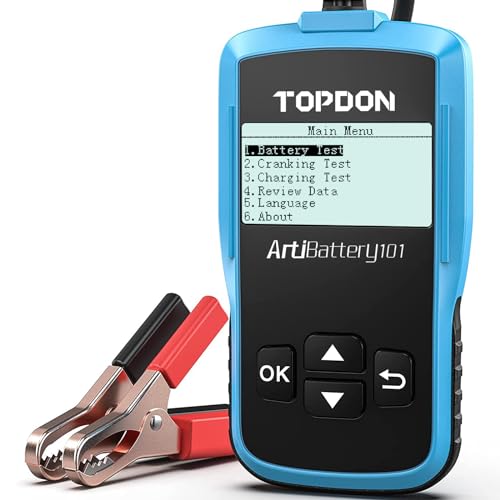
TOPDON AB101 12V Car Battery and Charging System Tester
The TOPDON AB101 is a versatile car battery tester designed for 12V batteries, including flooded, AGM, and gel types. It accurately assesses battery health, cranking performance, and charging system status, providing clear results in seconds. Lightweight and easy to use, it offers safety features and multilingual support, making it ideal for both beginners and experienced users.
Key Features:
- Accurately tests battery health and provides replacement advice based on direct benchmarking.
- Compatible with most 12V batteries, including regular flooded, AGM flat plate, AGM spiral, and gel types; supports CCA, BCI, CA, MCA, JIS, DIN, IEC, EN, SAE, and GB standards.
- Measures actual cranking voltage and time to diagnose starter system performance.
- Checks 12V charging system to verify generator output, rectifier diode function, and charging current control.
- Lightweight design with easy-to-read backlit screen displaying results in 3 seconds.
- Multilingual interface supporting English, Russian, Spanish, French, German, and Italian.
- Rubber-covered metal alligator clips enhance user safety.
- Menu-driven operation suitable for beginners.
- Includes a 1-year warranty.
Pros
- Quick and accurate battery and charging system diagnostics.
- Supports a wide variety of 12V battery types and standards.
- User-friendly with backlit screen and multiple languages.
Cons
- Limited to 12V systems only.
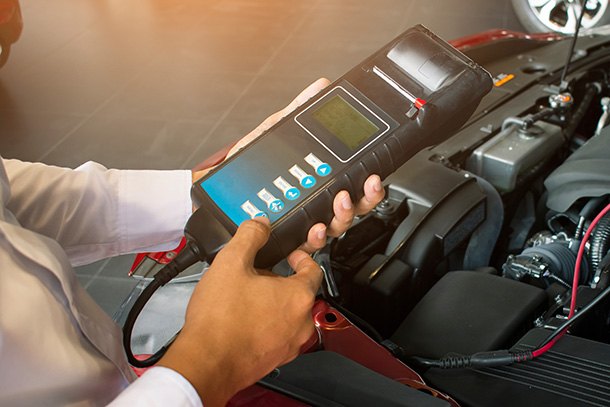
Feeling Left in the Cold? Your Battery Might Be to Blame
There's nothing like the frustrating jolt of turning your car key only to hear silence, or worse, that slow, pitiful click from a dead battery. It's a scenario many of us have been through, sometimes at the worst possible moment. You know the feeling , that sudden realization that your battery wasn't up to snuff. Wouldn't it be nice if you had a simple way to check your battery's health before it leaves you high and dry?
Enter car battery testers, those handy little gadgets that can save the day , or at least your day's plans. But before you start imagining a complicated tool requiring a degree in auto mechanics, relax. These devices are designed to be pretty straightforward and are a must-have in any car owner's toolkit.
Why Should You Care About Testing Your Battery?
You've likely heard that batteries die in winter or after years of loyal service. Well, while that's generally true, there's a subtlety here: your battery doesn't always just fail outright. Often, it loses capacity bit by bit, making it sluggish on colder mornings or during heavy electrical loads.
Reviews you may find interesting:
8 Best Car Air Fresheners (2026 Review Guide)8 Best Jump Starters With Built-In Air Compressors (2026 Review Guide)
10 Best Car Starters (2026 Review Guide)
Regular battery testing can reveal these weaknesses early on. Imagine the peace of mind you get from knowing your ride's power source is healthy and ready , that's pure gold. Plus, a weak battery can also stress other components like the alternator, leading to more expensive repairs down the road.
So, keeping tabs on your battery isn't just about avoiding a no-start; it's about preserving your car's overall health. Kind of like visiting the doctor for a checkup before symptoms become a real headache.
What Makes a Car Battery Tester Great?
There's a variety of testers out there, but what's the difference? At the end of the day, a reliable tester will give accurate results quickly, without requiring an engineering background. Here's the gist of what to look for:
- Accuracy: You want readings you can trust. Some cheap testers might give a 'good' reading even when the battery's on the edge.
- Compatibility: Your car battery might be a standard lead-acid, AGM, or even a gel cell. The tester needs to handle your specific type.
- Ease of Use: Nobody wants a confusing interface. Look for clear displays, intuitive controls, and simple connection clips.
- Additional Features: Extras like load testing, CCA (Cold Cranking Amps) measurement, or even alternator checks can add real value.
- Portability: A lightweight, compact tester means you can stash it in the glove box and have it handy anytime.
Honestly, if you find a tester covering these bases, you're halfway there already.
How Does Testing Actually Work? Let Me Explain
Think of your battery like a bucket of water: the tester essentially measures how much juice is left in that bucket and how well it can deliver when the engine demands it. Most testers connect to your battery terminals and provide a voltage reading and sometimes a load simulation.
If the voltage is low or the battery can't maintain voltage under load, that's a red flag. Some advanced testers even estimate the remaining battery life or assess the alternator's performance.
You don't need to perform fancy maneuvers; just clip on the leads to the battery posts, follow a few on-screen prompts, and the tester will do the rest. It's like having a mini mechanic whispering the battery's secrets right into your ear.
Common Mistakes and How to Avoid Them
While these testers are pretty foolproof, it's easy to slip up. For example, connecting the clips in reverse is a rookie error that can cause sparks or inaccurate readings. Always double-check the polarity , positive to positive, negative to negative.
Also, testing a battery immediately after driving can give skewed results, because the battery is in a charged state. Give your car a break for at least a few hours before testing.
And hey, if it's raining or you're outside during winter chills, be cautious while handling your battery. Safety first, your fingers will thank you.
When Did You Last Test Your Battery?
If you're scratching your head wondering when the last battery check happened, that's a sign it's time. Don't wait for the tell-tale sluggish crank or dashboard warning lights , test now and be ahead of the game.
Maybe it's time to take out that battery tester from your toolbox or invest in one that feels right for you. Because at the end of the day, a healthy battery means fewer surprises and more smooth rides.
Wrap-Up: Your Battery's Best Friend
Look, car battery testers might not get the glam of flashier gadgets like GPS units or Bluetooth stereos, but their role? Absolutely crucial. They quietly guard you against those unexpected dead-battery days that nobody wants.
So, if you've not checked your battery lately, consider grabbing a tester that suits your needs. It's a small step toward hassle-free driving and one less thing to worry about on busy mornings or cold nights. After all, isn't peace of mind worth it?