8 Best ELM327 OBD-II Adapters (2026 Review Guide)
The Best Ranked ELM327 OBD-II Adapter
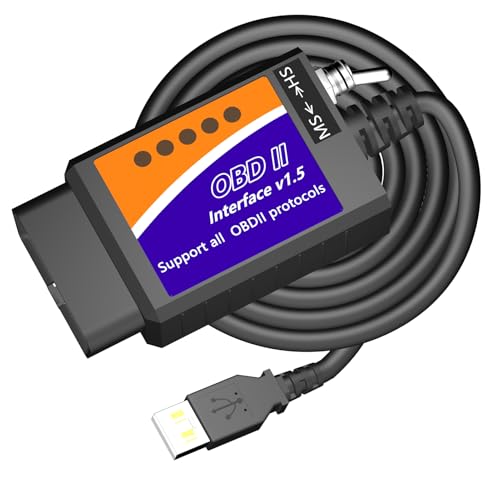
OBD2 to USB Diagnostic Cable for Windows Laptops
This OBD2 to USB cable lets you quickly diagnose and customize your vehicle's settings using a Windows laptop. It reads and clears trouble codes, monitors live sensor data, and supports advanced functions for Ford and Mazda vehicles. Ideal for DIY car repair and personalization, it works with most 12V vehicles made after 1996.
Key Features:
- Reads and clears diagnostic trouble codes (DTC) to identify and fix engine issues
- Monitors and displays live sensor data beyond dashboard capabilities
- Supports smog, EVAP, O2 sensor tests and freeze frame data
- Compatible with 12V vehicles from most brands made after 1996 including GM, Toyota, Ford, Chevy, Honda, Nissan, Hyundai, Kia, Subaru, and more
- Special Ford and Mazda customization options such as tire size calibration, trailer brake control, disabling chimes, enabling global window control, remote engine start, and others
- Supports various OBD software including FOR Scan, FoCCCus, Elmconfig, Scanmaster, PCMScan, and more
- Plug-and-play setup with driver and software installation on Windows laptops; programming guides included
Pros
- Works with a wide range of vehicle brands and models post-1996
- Advanced customization features for Ford and Mazda vehicles
- Comes with clear setup instructions and programming tutorials
Cons
- Customization functions are limited to Ford, Lincoln, Mercury, and Mazda only
- Requires Windows OS or emulator; no native Mac support
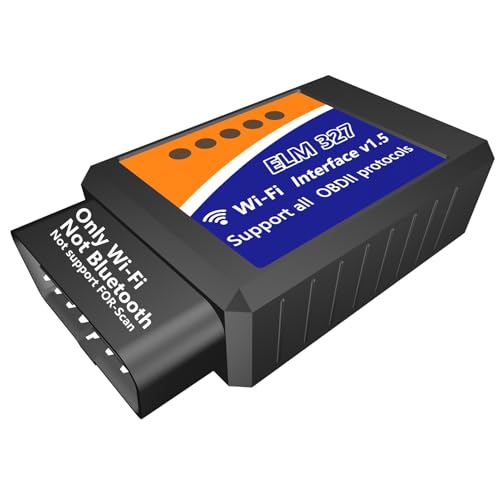
WiFi ELM327 OBD2 Car Diagnostic Scanner
This WiFi ELM327 OBD2 adapter is a handy diagnostic tool for car owners, allowing you to scan and clear fault codes, monitor live vehicle data, and check engine performance right from your smartphone or tablet. Compatible with most 12V cars made after 1996, it helps you detect issues early and maintain your vehicle without professional help.
Key Features:
- Connects via WiFi, not Bluetooth
- Scans and clears engine fault codes and check engine light
- Reads freeze frame data, live sensor data, vehicle info, and inspection readiness
- Supports smog, EVAP, and oxygen sensor tests
- Monitors detailed sensor information beyond dashboard readings
- Helps diagnose vehicle issues promptly to avoid damage or accidents
- Easy to use without professional mechanical skills
- Compatible with iPhone and Android devices
- Works with all apps supporting WiFi OBD2 connection; Torque app recommended for Android, Car Scanner for iPhone
- Supports all 12V vehicles manufactured after 1996
- Not compatible with motorcycles or FOR-Scan software
Pros
- Simple setup and use with mobile phones and tablets
- Comprehensive real-time vehicle diagnostics and monitoring
- Wide compatibility with various apps and devices
Cons
- Does not support Bluetooth connection
- Not compatible with motorcycles or FOR-Scan software
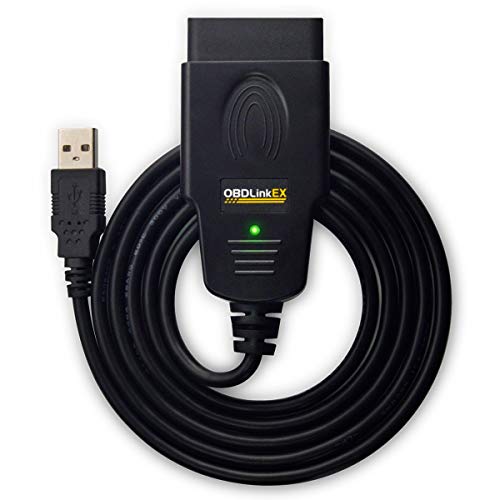
OBDLink EX FORScan OBD Adapter
The OBDLink EX FORScan OBD Adapter is a high-performance diagnostic tool designed specifically for Ford vehicles compatible with FORScan software. It enables dealership-level diagnostics, offering fast and reliable access to all vehicle systems through advanced electronic switching technology.
Key Features:
- Designed specifically for FORScan-compatible Ford vehicles
- Supports all Ford protocols and modules for comprehensive diagnostics
- Electronic switch allows simultaneous access to all CAN buses for advanced functions
- Data transfer speeds up to 20 times faster than toggle switch adapters
- Stable connection that prevents data loss and communication errors
Pros
- Provides dealership-level diagnostic capability
- Fast data throughput ensures efficient diagnostics
- Reliable and stable connection minimizes errors
Cons
- Limited to Ford and FORScan-compatible vehicles
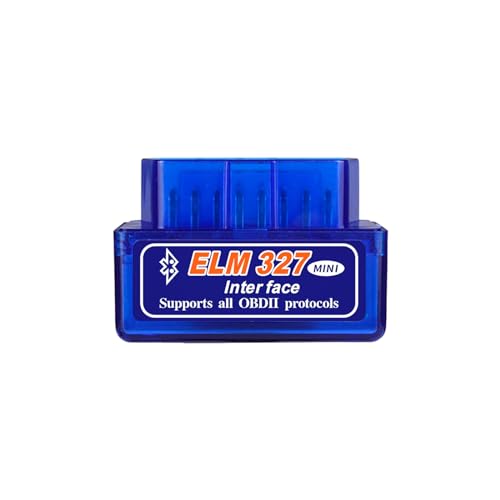
Bluetooth OBD2 Car Diagnostic Scanner
This Bluetooth OBD2 scanner provides reliable and accurate engine diagnostics for most 12V vehicles. It helps you quickly identify and clear engine fault codes, offers real-time data for analysis, and is compact enough for convenient storage in your glove compartment. Easy to install and compatible with Android devices using the Torque app, it's a practical tool for DIY vehicle maintenance.
Key Features:
- Reads and clears engine fault codes to identify the cause of the check engine light
- Provides real-time data feedback for quick vehicle analysis
- Durable ABS construction offers impact and corrosion resistance
- Simple setup: plug into OBD2 port and connect via Bluetooth with PIN 1234
- Compact size fits easily in your glove compartment for on-the-go use
- Compatible with most 12V vehicles (excludes hybrid and electric)
- Works with Android devices using the free Torque app
Pros
- Accurate and quick engine diagnostics
- Easy to use with straightforward Bluetooth setup
- Compact and durable design
Cons
- Not compatible with hybrid or electric vehicles
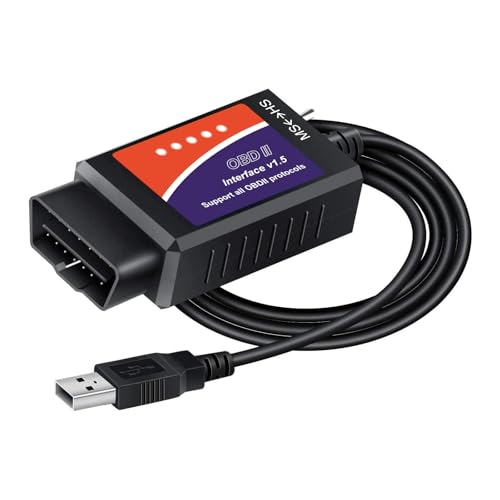
ELM327 USB OBD2 Diagnostic Scanner for Ford, Lincoln, Mazda, and Mercury
This ELM327 USB OBD2 scanner offers reliable, professional-grade diagnostics for Ford, Lincoln, Mazda, and Mercury vehicles from 1996 onwards. Featuring MS CAN and HS CAN switches, it supports a wide range of protocols and enables advanced functions like clearing fault codes, configuring modules, and unlocking hidden vehicle features. Compatible with popular software on all Windows systems, it's an essential tool for quick and accurate vehicle diagnostics.
Key Features:
- Equipped with MS CAN and HS CAN switches for efficient troubleshooting and clearing of fault codes.
- Supports all major OBD2 protocols including J1850PWM, HS CAN, MS CAN, HS CAN2, and HS CAN3.
- Compatible with Ford, Lincoln, Mazda, and Mercury models from 1996 onwards, including updated support for 2017-2019 models.
- Enables unlocking hidden vehicle features like global window control, Bambi mode, trailer brake controller, and tire size calibration.
- Works with various software such as Elmconfig, FoCCCus, FF2, and Scanmaster on 32/64-bit Windows systems.
- USB wired connection ensures stable and reliable communication, better than wireless alternatives.
- Simple setup: install the CH340T driver, connect to the vehicle's OBD2 port, and launch your diagnostic software.
Pros
- Stable and reliable USB connection for professional diagnostics.
- Supports a wide range of Ford-related vehicle models and protocols.
- Unlocks advanced and hidden vehicle functions for customization.
Cons
- Not compatible with trailers or semi-trailers.
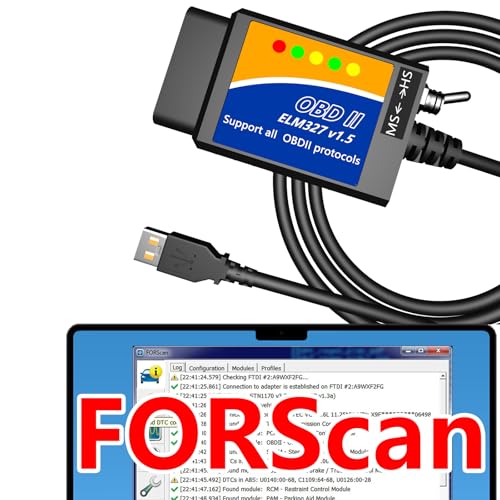
Ford OBD2 USB Diagnostic Scan Tool for FORScan
This USB OBD2 scan tool is designed for Ford, Lincoln, Mercury, and Mazda vehicles. Compatible with FORScan software, it allows you to read and clear diagnostic trouble codes, access unique vehicle functions, customize settings, and perform programming tasks easily from your Windows laptop.
Key Features:
- Compatible with FORScan software for advanced diagnostics and programming on Ford, Lincoln, Mercury, and Mazda vehicles.
- Supports vehicles from 1996 to 2023 for Ford, Lincoln, and Mercury; Mazda support up to 2022 models including partial support for new Mazda 3, CX-30, MX-30, CX-50.
- Scans and clears fault codes and check engine light warnings effectively.
- Accesses hidden modules and personalizes vehicle functions like lighting, chimes, and more.
- Reads and displays detailed sensor data and PIDs beyond standard OBD2 capabilities.
- Performs specific tests, service procedures, configuration, and programming.
- Allows customization of lighting controls, including fog lights, daytime running lights, and turn signals.
- Enables key and alarm adjustments such as disabling panic horn and chime control settings.
- Modifies instrument panel, radio, and navigation settings, including themes, Bluetooth names, and screen displays.
- Controls glass, engine, electrical, and comfort functions like window operation, mirror folding, remote start, and seat functions.
Pros
- Broad vehicle compatibility with detailed Ford and Mazda model support.
- Advanced functionality via FORScan software for in-depth customization and diagnostics.
- Simple USB connection with Windows laptops for easy use.
Cons
- Partial support for some newer Mazda models may limit full functionality.
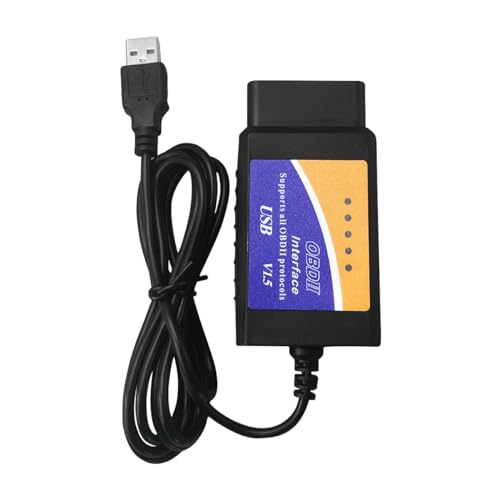
ELM327 USB OBD2 Diagnostic and Coding Tool
This ELM327 USB OBD2 adapter allows you to diagnose engine issues, clear codes, and perform advanced programming on OBD2-compliant vehicles. Compatible with most Windows systems and supporting all OBD2 protocols, it offers extensive vehicle compatibility for models post-1996. The durable, waterproof design ensures reliable performance during professional diagnostics and coding.
Key Features:
- Reads and clears engine codes for accurate diagnostics
- Compatible with all OBD2 protocols and most Windows versions
- Supports advanced functions like global window control, Bambi mode, idle security, and trailer brake coding
- Works with vehicles manufactured after 1996 with a 16-pin DLC under the dash
- Durable PVC construction that is scratch-resistant, waterproof, and dust-proof
Pros
- Wide compatibility with most OBD2 vehicles
- Supports advanced vehicle programming features
- Durable and waterproof build ensures longevity
Cons
- Not compatible with vehicles requiring specific security chips
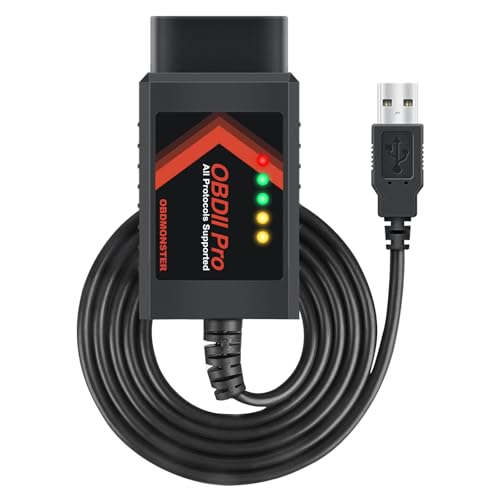
ELM327 OBD2 USB Diagnostic Adapter for Windows
This ELM327 OBD2 adapter offers seamless vehicle diagnostics and programming for a wide range of cars and trucks, especially Ford F-series models. Plug into your vehicle's OBD port and connect to a Windows laptop to read and clear fault codes, monitor sensors in real-time, and customize various vehicle settings with ease.
Key Features:
- Compatible with most Ford F150, F250, F350, F450, Ranger, and other cars and trucks using 12V OBD2 ports from 1996 onward. Not compatible with Mazda 3 and CX-30 models from 2019 and newer.
- Automatically switches between medium and high speed CAN protocols without manual intervention for faster, hassle-free diagnostics.
- Supports programming functions such as disabling double horn honks, enabling mirror auto-fold, Bambi mode, resetting daytime running lights, and brake controller programming.
- Reads and clears fault codes, monitors various vehicle systems including engine, gearbox, ABS, airbag, and climate control in real-time.
- Requires a Windows laptop and installation of the USB driver and diagnostic software from the official Forscan website.
Pros
- Wide compatibility with many Ford and other vehicle models
- Automatic protocol switching for faster and more reliable connection
- Allows both diagnostics and programming features
Cons
- Limited to Windows operating systems only
Getting to Know Your ELM327 OBD-II Adapter
If you've ever been curious about what those mysterious blinking lights on your dashboard mean, you're not alone. That little code can sometimes feel like an indecipherable riddle from your car's inner workings. Enter the ELM327 OBD-II adapter: your personal translator between you and your vehicle's brain.
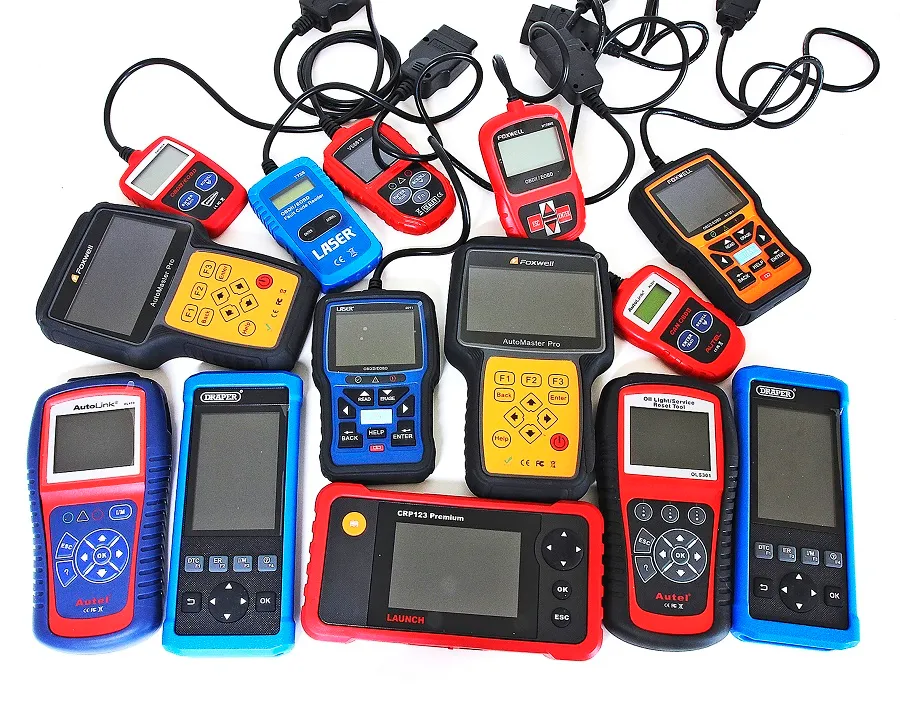
This nifty gadget slots right into your car's OBD-II port (usually under the dash) and connects wirelessly or through a cable with your phone or computer. What happens next? Well, a wealth of data springs to life, ranging from engine parameters to emissions info. Suddenly, you're not just a driver, you're a car detective.
Why This Little Device Packs a Punch
you might wonder, "While it sounds useful, but do I really need one?" It's a fair question. Honestly, it's like having a stethoscope for your car. If you're the kind who loves to tinker or just wants to avoid surprise repair bills, it's a game changer. Imagine saving time at the shop or understanding why your check engine light popped up, without feeling totally lost.
Reviews you may find interesting:
9 Best Car Portable DVD Players (2026 Review Guide)8 Best Car Paint Pens (2026 Review Guide)
9 Best Key Finders (2026 Review Guide)
Plus, if you're eco-conscious, keeping tabs on your emissions and fuel consumption using the adapter can lead to behaviors that help both your wallet and the planet.
How Does It Work? Breaking It Down
You plug the ELM327 into the OBD-II port, it's that simple. Your car speaks in various protocols that can be complex, but this adapter listens in and converts all that vehicle jargon into something readable for your apps. From there, you can spot trouble codes, monitor sensor data in real-time, and even reset warning lights if everything checks out.
Decoding Connectivity: Bluetooth, Wi-Fi, or USB?
When it comes to hooking up your adapter, choices abound. Bluetooth is super popular, especially for Android users. It's quick, wireless, and pretty hassle-free. Wi-Fi adapters also offer wireless connectivity and tend to work smoothly with iPhones, which can be a bit fussier about Bluetooth connections.
Then there's USB, reliable, no frills, and great for those who prefer wired connections, especially with laptops.
Choosing the right connection boils down to your device and how you like to work. If you're hopping between cars or devices, Bluetooth's flexible nature could win you over. But no matter the tech, what really counts is ease of use and stable performance.
Features That Matter (Beyond the Basics)
Not all ELM327 adapters are cut from the same cloth. While they all handle the basics, reading and clearing codes, some go the extra mile. Here's what to keep an eye on:
- Compatibility: Check if your car's protocol is supported. Some adapters are more versatile with older or less common models.
- Update Capability: Firmware that gets updates means your adapter stays relevant as vehicle tech evolves.
- Speed and Responsiveness: No one wants to wait forever for data, so smooth, quick reads make the experience less of a chore.
- App Support: Since the adapter itself is just the hardware, having access to reliable and user-friendly apps enriches the whole process.
- Build and Size: A compact design ensures it won't get in the way or risk damage while connected.
The Other Side: What Could Be Improved?
Here's the thing: while ELM327 adapters are fantastic for everyday diagnostics, they're not all-powerful. Some cheap clones flood the market, leading to buggy connections or compatibility help. It's worth paying a smidge more for trustworthy quality. Besides, you don't want your diagnostic session to turn into a test of patience.
Also, remember that some advanced vehicle systems may need more specialized equipment beyond what an ELM327 can provide. For the typical driver or enthusiast though, it's surprisingly capable.
A Quick Chat About Safety and Privacy
Using these adapters means connecting your car's internal computer to your device. It's smart to consider security, especially with wireless adapters. You wouldn't want unauthorized folks snooping on your data or poking around your vehicle systems.
Make sure to use trusted apps, keep your adapter's firmware updated, and disconnect it when not needed. Treat it like any gadget that handles sensitive info, it pays to be cautious.
Wrapping It Up: Why You'll Probably Love Having One
Honestly, having an ELM327 adapter parked in your glove compartment feels a little like carrying a secret weapon, except it's legal and actually encourages good habits. The satisfaction of spotting and fixing a persistent issue yourself, or just checking up on your car's health before a long trip, is hard to beat.
Even if you're not the hands-on type, being informed about what your car is 'thinking' can save stress down the road. Plus, it's just kind of cool to understand the language of your machine. Who said cars and tech can't have a little heart and soul between them?
So, whether you're a weekend warrior, a daily commuter, or someone who likes to peek under the hood without popping it open, an ELM327 OBD-II adapter is a handy companion. It's not just a tool, it's a little piece of insight that fosters confidence and connection with your car.
Fancy a smoother ride? Start talking to your car the easy way.