9 Best Automotive Multimeters (2026 Review Guide)
The Best Ranked Automotive Multimeter
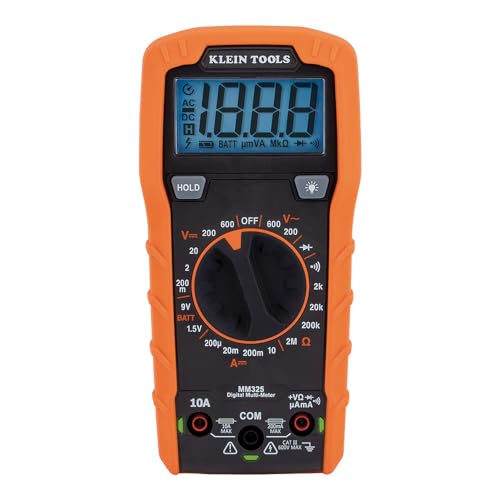
Klein Tools MM325 Digital Multimeter
The Klein Tools MM325 is a reliable digital multimeter designed for measuring AC/DC voltage up to 600V, current, resistance, and testing diodes and batteries. Its clear backlit display and lead-alert indicators ensure accurate and safe readings, while its durable build and convenient features make it suitable for a wide range of electrical tasks.
Key Features:
- Measures AC/DC voltage up to 600V, DC current up to 10A, and resistance up to 2M
- Includes continuity, diode test, and battery test functions
- LED indicators confirm correct test lead placement for safe measurements
- Backlit LCD display for clear readings in low-light conditions
- Battery test mode to check battery condition
- Test lead holders, built-in kickstand, and optional magnetic hanger for hands-free use
- Durable design withstands drops up to 6.6 feet
- Comes with test leads featuring CAT III/CAT IV safety caps, instructions, and 2 AAA batteries
Pros
- Accurate measurements with lead-alert safety indicators
- Clear visibility with backlit display
- Robust and drop-resistant design
Cons
- Manual ranging may be less convenient for beginners compared to auto-ranging models
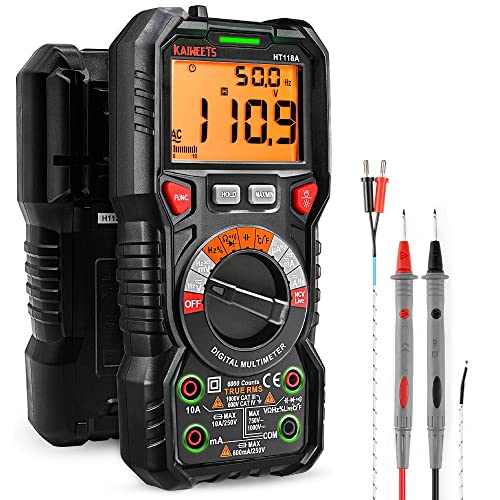
KAIWEETS Digital TRMS Multimeter 6000 Counts
The KAIWEETS Digital TRMS Multimeter is a versatile, easy-to-use tool designed for accurate electrical measurements. Suitable for automotive and general electrical testing, it offers wide-ranging capabilities including voltage, current, resistance, temperature, and more. Its intuitive interface, durable construction, and safety features make it a reliable choice for both professionals and hobbyists.
Key Features:
- Measures up to 1000V DC and 750V AC voltage, 10A AC/DC current, and 60 M resistance
- Tests temperature, capacitance, frequency, duty cycle, diodes, and continuity
- Auto-ranging with a large 2.9-inch backlit LCD for clear readings
- Non-contact voltage detection with sound and light alarm
- Built-in flashlight for use in low-light conditions
- Min/Max/Average function to monitor signal fluctuations
- Stable kickstand and pen slot for convenience
- Safety rated IEC CAT III 1000V and CAT IV 600V with fuse and thermistor protection
- Double insulated with silicone protective case to prevent damage
- Includes test leads, thermocouple, batteries, and user manual
Pros
- Wide measurement range covering multiple electrical parameters
- User-friendly auto-ranging and clear backlit display
- Strong safety protections and durable design
Cons
- Cap requires removal before use which may be inconvenient
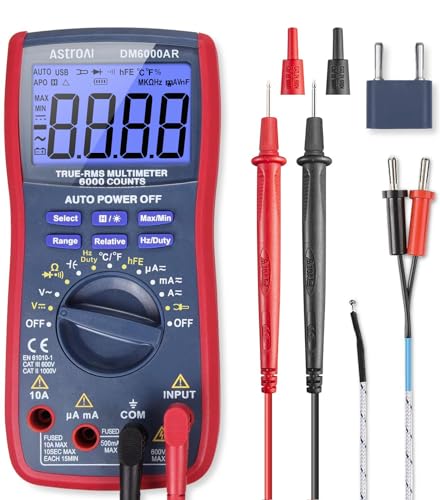
AstroAI True RMS Digital Multimeter with Auto-Ranging
The AstroAI Digital Multimeter is a reliable and versatile tool for accurately measuring voltage, current, resistance, capacitance, temperature, and more. Designed for both automotive and household electrical troubleshooting, it features a large backlit display, True RMS capability, and safety protections to ensure accurate readings and durability during use.
Key Features:
- Measures AC/DC current, AC/DC voltage, resistance, capacitance, frequency, duty cycle, diode, continuity, and temperature
- Auto-ranging function and True RMS for precise AC measurements
- Large backlit LCD screen with data hold and auto shut-off features
- Kickstand for hands-free operation
- Safety protection with double ceramic, explosion-proof fuses
- Ideal for automotive and household electrical troubleshooting
Pros
- Accurate True RMS measurements for both AC current and voltage
- User-friendly design with backlit display and kickstand
- Robust safety features including dual ceramic fuses
Cons
- Test lead caps must be removed before use, which may be overlooked
- Manual required for full feature understanding
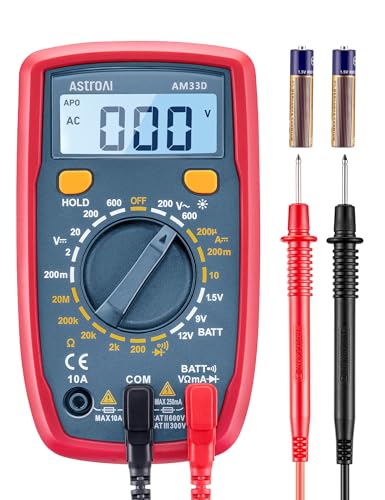
AstroAI Digital Multimeter for Voltage, Current, Resistance and Continuity Testing
This AstroAI digital multimeter offers accurate measurements for AC/DC voltage, current, resistance, and continuity, making it an essential tool for both household and automotive electrical troubleshooting. It features a clear backlit LCD display, protective silicone cover, and safety elements like a double fuse to prevent overload. Ideal for testing batteries, outlets, fuses, and automotive circuits with ease and reliability.
Key Features:
- Measures AC/DC voltage, DC current, resistance, diode, and continuity accurately
- Sampling speed of 2 readings per second with a 3.5-digit (1999 count) backlit LCD display
- Double fuse protection and silicone cover ensure safety from overload and damage
- Includes data hold, auto shutoff, and continuity buzzer for enhanced usability
- Comes with batteries, test leads, and user manual for immediate use
- Limitations: Cannot test all AC current and AC voltage below 100mV; ensure proper lead connection and dial positioning
Pros
- Accurate and versatile measurements suitable for household and automotive use
- Backlit display and continuity buzzer improve usability in various conditions
- Built-in safety features protect both user and device
Cons
- Unable to measure all AC current and low AC voltages under 100mV
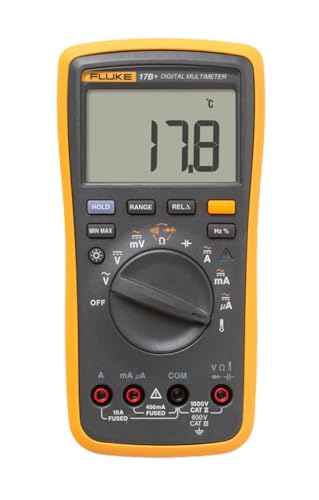
Fluke 17B+ Digital Multimeter
The Fluke 17B+ Digital Multimeter is a reliable and versatile tool designed for electrical professionals and DIY enthusiasts. It offers accurate measurements of voltage, current, resistance, capacitance, frequency, and temperature, making it ideal for troubleshooting and maintenance tasks in residential, commercial, and industrial environments.
Key Features:
- CAT III 600V safety rating for protection during electrical work
- Measures AC/DC voltage up to 1000V and current up to 10A
- Measures resistance, continuity, and capacitance for effective troubleshooting
- Includes diode testing to quickly identify faulty components
- Temperature measurement up to 400C with the included type K thermocouple
Pros
- Wide range of measurement functions in a single device
- High safety rating suitable for many electrical environments
- Temperature measurement capability adds extra versatility
Cons
- Limited to 10A current measurement, may not suit high-current applications
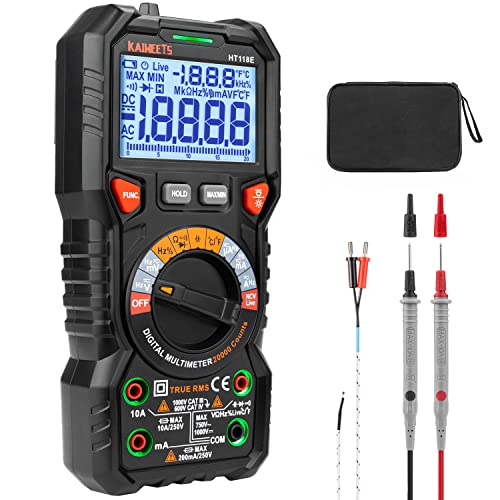
KAIWEETS HT118E Digital Multimeter with 20000 Counts and Auto-Ranging
The KAIWEETS HT118E Digital Multimeter provides precise measurements with its high resolution 20000-count display and advanced TRMS technology. Designed for both professionals and hobbyists, it offers versatile functions including voltage, current, resistance, temperature, and more. Its user-friendly features like LED-lit jacks, backlit display, and a stable kickstand make it convenient to use in various environments. Built with safety in mind, it is IEC rated and comes with protective features to ensure reliable operation.
Key Features:
- 20000-count high-resolution display for accurate measurements
- Built-in flashlight for ease of use in low light conditions
- Min/Max recording to track signal fluctuations
- Stable kickstand and pen slot for hands-free operation
- Measures AC/DC voltage and current, resistance, temperature, capacitance, frequency, duty cycle, diodes, continuity, and non-contact voltage
- LED indicators guide correct probe placement
- Auto-ranging function simplifies measurement selection
- Backlit LCD screen for easy reading in dark environments
- Safety certified with IEC CAT III 1000V and CAT IV 600V ratings
- Double ceramic fuse, thermistor protection, and silicone cover for enhanced safety and durability
- Includes test leads, thermocouples, batteries, user manual, and carrying case
Pros
- High accuracy with 20000 counts and true RMS measurements
- Wide range of measurement functions suitable for various applications
- User-friendly interface with LED indicators and auto-ranging
Cons
- Backlight brightness could be higher for extremely dark conditions
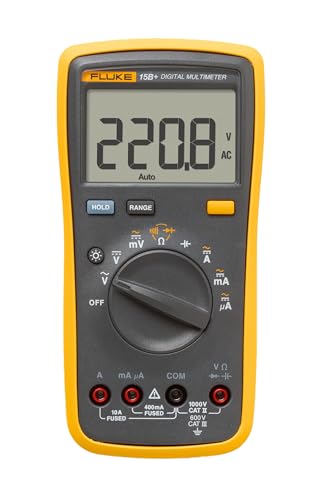
Fluke 15B+ Digital Multimeter for Electrical Measurements
The Fluke 15B+ is a reliable digital multimeter designed for accurate electrical measurements including voltage, current, resistance, continuity, diode testing, and capacitance. Suitable for residential, commercial, and automotive applications, it offers safety and precision with a CAT III 600V rating and measurements up to 1000V and 10A.
Key Features:
- CAT III 600V safety rating for protection during electrical work in residential and commercial environments
- Measures AC and DC voltage up to 1000V for versatile electrical testing
- Measures AC and DC current up to 10A for diagnosing electrical issues
- Includes functions for voltage, resistance, continuity, diode, and capacitance testing
- Dedicated input terminal for accurate current measurements up to 10A
Pros
- High safety rating ensuring secure use in various electrical settings
- Wide measurement range covering voltage, current, and other essential electrical parameters
- User-friendly with multiple diagnostic functions for troubleshooting
Cons
- Limited to current measurements up to 10A, which may not cover all high-current applications
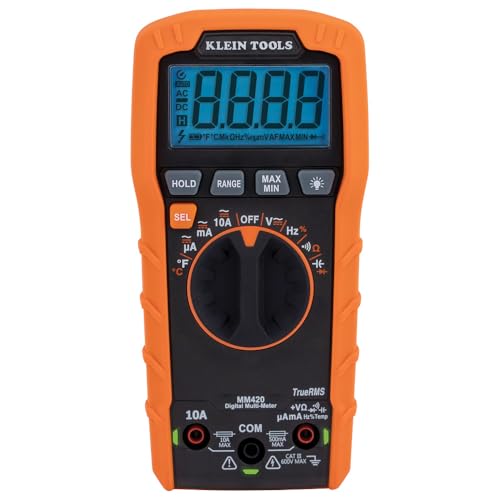
Klein Tools MM420 Auto-Ranging Digital TRMS Multimeter
The Klein Tools MM420 is a reliable digital multimeter designed for accurate electrical measurements. Featuring True RMS technology and auto-ranging capabilities, it measures voltage, current, resistance, and more with precision. Its durable build and convenient features make it suitable for residential, HVAC, and light industrial use.
Key Features:
- Measures AC/DC voltage up to 600V, AC/DC current up to 10A, and resistance up to 50M
- Includes tests for continuity, temperature, capacitance, frequency/duty cycle, and diode
- LED indicators for proper test lead placement to ensure safety and accuracy
- Backlit LCD display for easy reading in low-light environments
- Auto-ranging with True RMS for precise measurements
- Built-in test lead holders, kickstand, and optional magnetic hanger for hands-free operation
- Durable design withstands drops up to 6.6 feet (2 meters)
- Comes with test leads equipped with CAT III/CAT IV safety caps, thermocouple, instructions, and batteries
Pros
- Accurate True RMS measurements with auto-ranging
- Clear backlit display suitable for low-light conditions
- Rugged construction ensures durability on job sites
Cons
- Magnetic hanger sold separately
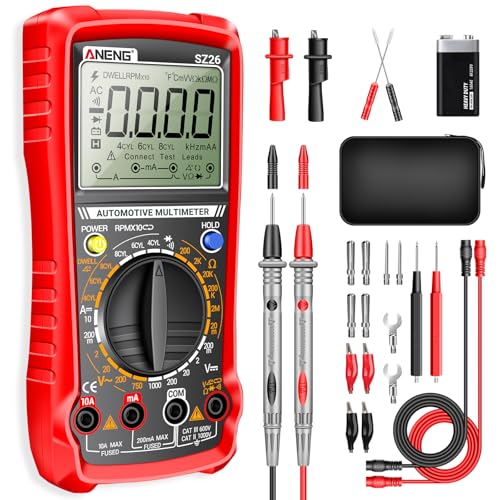
ANENG SZ26 Digital Automotive Multimeter
The ANENG SZ26 is a versatile digital multimeter designed specifically for automotive diagnostics. It offers precise measurements including RPM, dwell angle, voltage, current, resistance, and duty cycle. Built for durability and ease of use, it features a large LCD, overload protection, and a comprehensive accessory kit, making it an essential tool for mechanics, engineers, and car enthusiasts.
Key Features:
- Measures 500-10000 RPM tachometer readings, dwell angle, DC current, AC/DC voltage, resistance, and duty cycle
- Rugged, shockproof protective case with built-in stand for hands-free operation
- Large, clear LCD display for easy reading in various lighting conditions
- Accurate measurements with 1999 counts and overload protection for device and user safety
- Comes with a full accessory kit including test leads, alligator clips, needles, battery, manual, and storage bag for portable use
Pros
- Wide range of automotive diagnostic functions
- Durable and shockproof design
- Comprehensive accessory kit included
Cons
- May have a learning curve for beginners unfamiliar with advanced automotive measurements
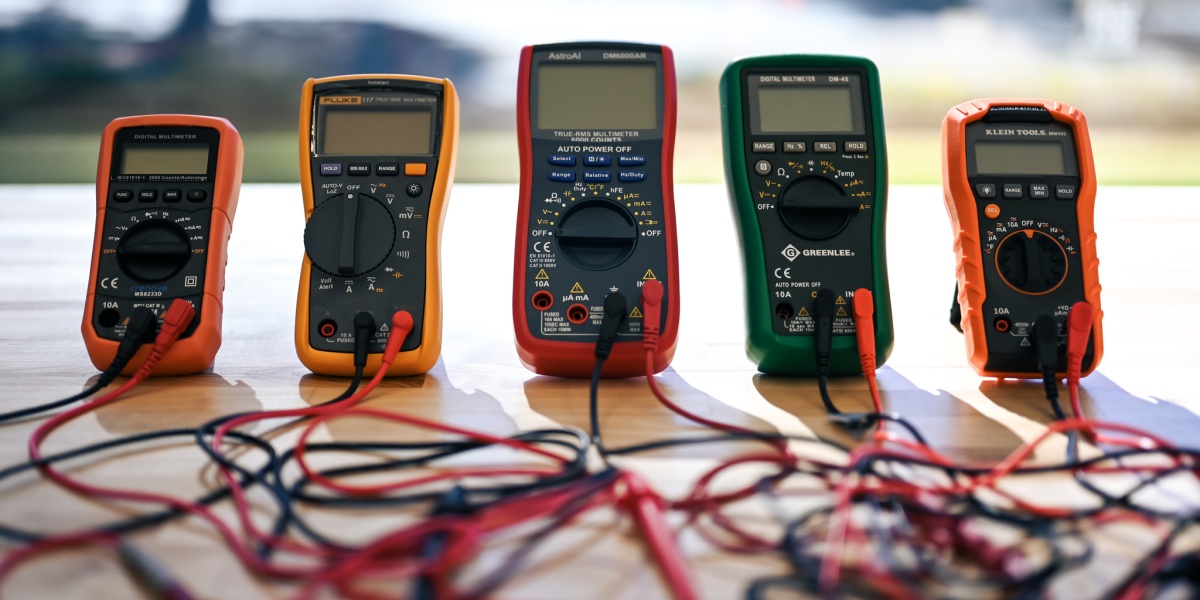
Why Every Car Enthusiast Needs a Good Automotive Multimeter
So, you've got a car that's been acting up, or maybe you just want to keep things in tip-top shape. Ever wondered how pros figure out what's wrong with your vehicle's electrical system without tearing apart the entire engine? Yep, that's where an automotive multimeter steps into the spotlight. These devices aren't just gadgets; they're like the stethoscopes for your car's electrical heartbeat.
Honestly, having one of these tools at your fingertips can save you loads of time, money, and headache. Picture trying to test your car's battery or troubleshoot a wonky alternator without one, it's a guessing game you just don't want to play.
What's So Special About Automotive Multimeters?
You might be thinking, isn't a multimeter just a multimeter? Well, not exactly. Automotive multimeters come geared with features that cater specifically to car electronics and battery systems.
They'll measure things like voltage, current, resistance, and sometimes even more specialized readings like RPM or temperature, all in a format that suits the automotive environment. Plus, their probes are often designed to handle the kind of connectors and spaces you find under the hood.
Reviews you may find interesting:
9 Best Driving Gloves (2026 Review Guide)7 Best Car Headlight Polishers (2026 Review Guide)
9 Best OBD-II Scanners Under 50 (2026 Review Guide)
Here's the thing: car electronics can be a little temperamental , currents surge, and voltages fluctuate depending on the engine's state. A reliable multimeter cops with these nuances so you get accurate readings every time.
How to Spot a Multimeter That Won't Let You Down
When shopping for an automotive multimeter, it's easy to get lost in specifications and marketing jargon. So, what actually matters?
- Accuracy: This is the bread and butter. You want readings you can trust. Look for models that boast tight tolerance levels.
- Durability: A multimeter is usually part of your garage arsenal, where it sees grease, drops, and maybe even the occasional spill. Rugged construction and solid casing are non-negotiable.
- Ease of Use: You're not always going to be in the mood to decode an instruction manual. Simple controls and a clear display can make the whole process feel like a breeze.
- Safety Features: Automotive work involves high currents and voltages. Things like overload protection and insulated probes keep you safe when you're deep in diagnostics.
- Range of Functions: From testing batteries to checking continuity and RPM, the more versatile, the better, just don't get distracted by features you won't need.
Getting to Know the Ins and Outs of Multimeter Functions
By the way, It's not enough just to grab a multimeter and start poking around circuits. Understanding what each function does helps you avoid rookie mistakes.
Let me break down a few essential functions:
- Voltage Measurement (DC & AC): Crucial for seeing if your battery or alternator is delivering stable power.
- Current Measurement: Helps detect electrical draw or potential shorts.
- Resistance: Finds issues in wiring or components by testing if current can pass through.
- Continuity Test: The quick way to check if a circuit is complete, think of it as a bridge check.
- RPM Measurement: Some automotive multimeters include this to verify engine speed, which can be a lifesaver.
Taking the time to learn these helps you feel less like you're fumbling in the dark and more like you're calling the shots.
When the Rubber Meets the Road: Practical Tips for Using Your Multimeter
it's one thing to know what a multimeter does, and quite another to put it to savvy use in your garage. Here are some down-to-earth tips:
- Start with the basics: Before you jump into complex diagnostics, get comfortable measuring voltage and resistance on simple stuff.
- Double-check your settings: It's easy to set your multimeter to the wrong mode and get nonsense readings , or worse, cause damage.
- Keep safety front and center: Take precautions like disconnecting the battery when possible and don't touch live wires directly.
- Take notes: Keeping track of your readings over time helps identify intermittent problems that aren't obvious right away.
- Clean your probes: Dirty or oxidized probes can give lousy readings. A quick wipe can save confusion later.
And hey, remember, even the pros mess up sometimes. It's all part of the learning curve.
Does Price Reflect Quality? Sorting Fact from Fiction
While it's tempting to think the priciest multimeter will blow every other out of the water. But honestly, that's not always the case.
Some affordable models punch well above their weight with solid accuracy and features that cover the essentials for most car owners. Meanwhile, high-end units might throw in bells and whistles that only seasoned mechanics need.
The trick is matching your specific needs with what's available. Are you just tinkering on weekends? Or are you a professional working daily on complex systems? Asking yourself this question narrows down the field drastically.
Wrapping It Up: Why the Right Multimeter Matters
Think of your automotive multimeter as a trusty sidekick. It helps spot trouble before it turns into a costly repair, gives you confidence tackling electrical issues, and makes your relationship with your car a whole lot smoother.
So next time your dashboard lights flicker or your engine seems off, don't just sigh and grimace, grab your multimeter, and get to the root cause like a pro. Trust me, your car and your wallet will thank you.